

Although artificial intelligence (AI) has been expanding at a breakneck pace in recent years, 2025 is looking to be the year when it becomes genuinely ubiquitous.
AI has begun to alter how we live, work, and think, from your phone to your office, and even in unexpected places. Even though we frequently hear about chatbots and self-driving cars, there is a lot of AI going on that the general public is unaware of.
These 15 startling facts about artificial intelligence in 2025 will alter your perspective on the technology and possibly the future.
Table of Contents
Artificial Intelligence Is Now Able to Create Its Own Models
The fact that AI is learning to create better AI is one of the most significant changes in 2025. This has advanced to a new level and is known as AutoML (Automated Machine Learning). Advanced AI systems can optimize their own design rather than waiting for human developers to make adjustments to algorithms. Why it’s surprising: This indicates that AI is developing at a quicker rate than humans, which may result in advancements occurring much more quickly.
Artificial Intelligence Models Are Increasingly Energy-Saving
Although it’s common knowledge that artificial intelligence (AI) consumes a lot of processing power, researchers have made significant progress in creating AI processors that require less energy in 2025. These processors provide the same functionality but consume up to 90% less energy.
Why it matters: AI will become more affordable to operate, more sustainable, and simpler to incorporate into smaller technologies like wearables and home appliances.
Artificial Intelligence Is Transforming Space Travel
By 2025, artificial intelligence is accelerating the search for undiscovered planets. Instead of taking months to find potential habitable planets, NASA and private space businesses now utilize artificial intelligence (AI) to sort through millions of telescope photos.\
Why it’s surprising: Humans just cannot process so much data at such a rapid pace, therefore some of these planets would have gone unnoticed entirely in the absence of AI.
Artificial Intelligence Is Able to Forecast Health Issues Years Ahead
These days, medical AI is so sophisticated that it can identify early warning indications of conditions like cancer, heart failure, and Alzheimer’s years before symptoms show up.
Why it matters: Doctors may stop diseases before they even begin as a result of this, making preventative healthcare the standard.
Artificial Intelligence Is Developing Emotional Intelligence
No, AI hasn’t evolved emotions, but by 2025, AI systems will be able to understand body language, speech tones, and facial expressions with greater than 95% accuracy.
Why it’s surprising: Conversations feel more human now that customer support bots and applications for mental health support adjust their responses according to your emotional state.
Artificial Intelligence Is Generating Novel Scientific Hypotheses
By 2025, AI will be doing more than just evaluating data; it will be developing original scientific hypotheses that people had never even thought about. For instance, physicists are currently testing a new dark matter concept proposed by AI.
Millions of dollars are being sold for Artificial Intelligence-generated art.
AI-generated literature, music, and paintings have advanced to the point that they fetch enormous prices at auction. Some are also on exhibit at prestigious institutions.
Why it matters: Although there is still disagreement about whether AI art qualifies as “real” art, the industry is expanding.
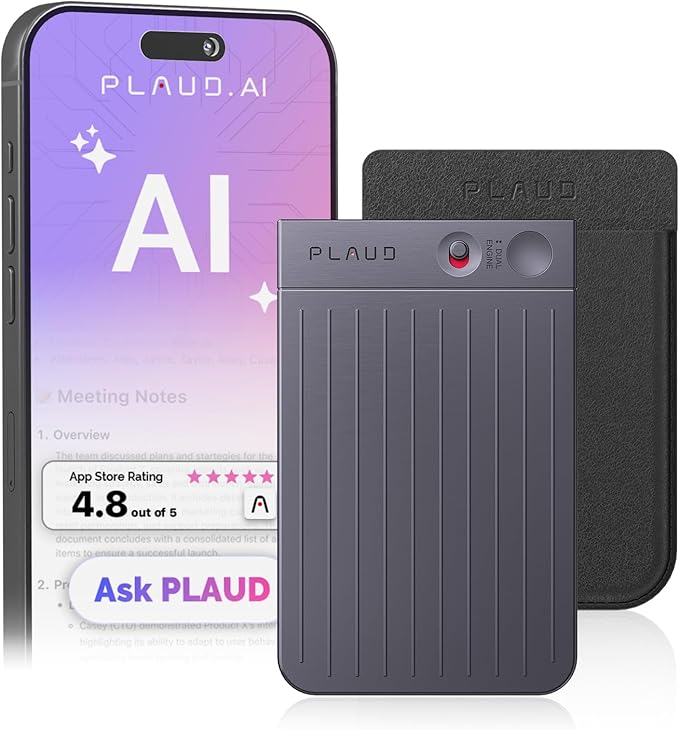
Artificial Intelligence Voice Recorder, PLAUD Note Voice Recorder w/Case, App Control, Transcribe & Summarize with AI Technology, Support 112 Languages, 64GB Memory, Audio Recorder for Lectures, Meetings, Calls, Black
Artificial Intelligence Is Breaking Down Language Barriers Instantaneously
By 2025, artificial intelligence (AI)-driven translation tools will be able to translate more than 150 languages immediately and with almost flawless accuracy, including slang and colloquialisms.
Why it’s surprising: You no longer need a translator to conduct a natural discussion with someone who speaks a totally other language.
The Application of Artificial Intelligence to Criminal Investigations
AI is being used by police departments to examine CCTV footage, crime scene images, and patterns of suspect activity. AI has already resolved cold cases that had gone unsolved for decades in some cities.
Why it matters: Although law enforcement AI is a fantastic tool, there is controversy about its ethics and privacy.
Artificial Intelligence-Powered Robots Are Not Only Found in Factories, But Also in Homes
By 2025, household robots will be more than just vacuum cleaners. They can automatically water your plants, fold laundry, and prepare simple meals.
Why it’s surprising: In many regions, the cost of an affordable home robot has fallen below $1,000, marking the beginning of its mainstreaming.
Artificial Intelligence Is Customizing Each Student’s Education
It in education currently adapts instruction to each student’s pace, learning preferences, and interests rather than using a one-size-fits-all approach.
Why it matters: According to preliminary research, AI-based learning platforms lower dropout rates and increase exam scores by 25%.

Cybersecurity Is Being Replaced by Artificial Intelligence
By 2025, artificial intelligence (AI) will be used to identify and thwart hacking attempts in real time, frequently before the attack occurs.
Why it’s surprising: There is a “AI vs. AI” cybersecurity conflict since cybercriminals are also utilizing AI.
Artificial Intelligence Writes Code Without Human Assistance
These days, developers use artificial intelligence (AI) techniques that may create whole systems from a brief description of your needs. For instance, the AI will write the code, develop the layout, and even set up the payment gateway if you say, “create a website for a bakery with an online order system.”
Artificial Intelligence Is Able to Perfectly Mimic
Any Voice By 2025, voice cloning AI will be able to replicate a human voice from ten seconds of audio.
Why it’s surprising: It raises serious worries about false information and scams, even as it’s helpful for movies, audiobooks, and accessibility.
Artificial Intelligence Is Taking Over as Your Personal Helper
Artificial Intelligence assistants will be able to manage your complete schedule, reservations for trips, food shopping, and reminders by 2025. They will even be able to predict your requirements before you do.
Why it matters: This translates into more time for creativity and leisure and less time spent on tedious chores.
Artificial Intelligence-Powered Innovation Is Dismantling Barriers in the Arts
For a long time, people thought that creativity was a quality that was exclusive to humans and that machines could never fully imitate. However, by 2025, artificial intelligence programs are creating creative music, painting beautiful artwork, and even authoring entire screenplays for motion pictures.
The initial results are getting quite decent, but these creations still require human refinement. In reality, some short films produced by Artificial Intelligence have won Oscars without anyone noticing they weren’t created by humans. This causes discussions around originality and ownership in the creative industry and blurs the distinction between human and computer craftsmanship.
Artificial Intelligence Helpers Can Now Listen Emotionally
It helpers are more than merely mechanical replies by 2025. They are able to infer your emotional tone from your facial expressions, word choice, and voice. After a difficult day, picture speaking to your gadget and having it react empathetically by recommending a soothing playlist, leading you through breathing techniques, or even putting you in touch with a friend. Although many find solace in this, it also begs the question of how much individuals may become emotionally dependent on computers.
Artificial Intelligence Is Acquiring Knowledge Without Human Assistance
Large volumes of labeled data were previously required for AI algorithms to learn. However, self-learning algorithms are increasingly achieving significant progress without continual human oversight. These Artificial Intelligence programs are able to recognize trends, make inferences, and develop themselves -similar to how people learn through experience. Innovation is accelerated by this capability, but it also makes it more difficult to forecast precisely how an AI will develop over time. This could be a step toward artificial general intelligence (AGI), according to some scientists.
Healthcare Artificial Intelligence Is Identifying Illnesses Years Ahead
Medical Artificial Intelligence systems developed in 2025 can now identify health problems years in advance, sometimes even before symptoms manifest. Artificial Intelligence can forecast the risk of diseases like Alzheimer’s, cancer, and heart disease by examining genetic information, lifestyle choices, and even minute variations in speech patterns. Long before ailments worsen, this early-warning ability is assisting physicians in taking preventative measures. But it also raises the moral conundrum of how much information about one’s future health is appropriate.

Artificial Intelligence Is Driving Smart Cities of the Future
AI-powered infrastructure is changing urban living. Drones transport groceries to your balcony, energy networks automatically adjust for efficiency, and traffic signals change in real time to ease congestion. Leading cities like Singapore and Dubai are demonstrating how Artificial Intelligence can improve the convenience, safety, and cleanliness of urban areas. However, cautious planning is also necessary for this high-tech development in order to prevent privacy issues and excessive surveillance.
Artificial Intelligence Is Joining Scientific Research as a Partner
By 2025, artificial intelligence has joined scientists as a research collaborator. Artificial Intelligence can handle years’ worth of study in a matter of minutes, from evaluating climate change data to finding novel chemical compounds for medical applications. Innovations in vaccine research and renewable energy have already resulted from this. Human-Artificial Intelligence cooperation is accelerating advancement in ways that were unthinkable ten years ago.
Regulation of Artificial Intelligence Is Changing Rapidly
Governments around the world are rushing to enact laws that guarantee safety and equity as Artificial Intelligence becomes more potent. In 2025, new legislation is being developed to control deepfakes, safeguard private information, and increase the transparency of Artificial Intelligence decision-making. Some nations are even establishing “Artificial Intelligence licenses” that businesses need to get prior to implementing specific Artificial Intelligence systems. Some believe that excessive regulation is necessary to prevent abuse, while others worry that it could impede innovation.
The Future of Artificial Intelligence in 2025 and Beyond
The majority of people’s expectations from a few years ago were greatly exceeded by the state of AI in 2025. In addition to being quicker and more intelligent, it is also more creative, human-like, and integrated into our daily lives.
However, there are drawbacks to this quick expansion as well, such as moral dilemmas, changes in employment, and concerns about how much control humans should give to robots.
Keeping ourselves informed is the most crucial thing we can do. Artificial Intelligence is here to stay, and our ability to influence its position in the future will improve with our understanding of it. By 2025, artificial intelligence is more than just a catchphrase; it is influencing our lives in ways we never could have predicted. AI is subtly propelling advancements that make our society faster, smarter, and more connected in a variety of fields, including healthcare, finance, education, and entertainment.
These 15 startling facts demonstrate the advancements in Artificial Intelligence while also serving as a reminder of the difficulties we still face. How we strike a balance between ethics and progress, inventiveness and prudence, will determine how develops in the future. There is little doubt that the influence of AI will continue to astound us; its journey has only just begun.