

Tech innovation is redefining space exploration
Looking up in the night sky used to make one wonder what was out there. We’re no longer merely wondering, though, because of the quick advancements in technology. Each year, research teams, private companies, and space agencies make incredible discoveries that push the limits of human understanding. However, this year has been remarkable.
The previous 12 months have demonstrated that our future lies not only on Earth but also among the stars, with discoveries of new planets that may harbor life and advances in deep space exploration. Let’s examine the year’s top seven space discoveries and how they are influencing our future.
Table of Contents
Discovery of an Earth-Like Exoplanet Closer Than Ever
One of astronomy’s main objectives has been to find a “second Earth.” The existence of Gliese 12 b, an Earth-sized planet circling a star only 40 light-years away, was verified this year by scientists using the James Webb Space Telescope.
Gliese 12 b’s position in the habitable zone—the ideal region where temperatures would permit the existence of liquid water—is what makes it so intriguing. It is more likely to support life since scientists think it might have an atmosphere like Earth’s.
Even though we aren’t ready to move there yet, this discovery is important because:
- From a cosmic perspective, it is rather close.
- It provides us with a specific goal for further research.
- It increases the likelihood of discovering new livable worlds in the area.
Potential missions to do additional in-depth research on this planet using next-generation telescopes are already being discussed by NASA and ESA. It simply made the notion of intergalactic travel a little more plausible.

The Moon’s South Pole Provides the First Direct Proof of Water
Water ice on the Moon was speculated by scientists for decades, particularly in permanently shaded craters close to the poles. The most convincing evidence to date was presented this year by the Chandrayaan-3 mission of the Indian Space Research Organization, which found water molecules trapped in the lunar soil at the south pole.
Why is this important? due to the fact that water is essential for space survival. Moon bases in the future might:
- Use water to grow food and drink.
- For rocket fuel, separate it into hydrogen and oxygen.
- Cut down on the need to import goods from Earth
In order to establish a permanent lunar outpost, NASA’s Artemis program intends to land humans close to this area in the next years. Making the Moon a useful starting point for trips to Mars and beyond is the goal of this finding, which goes beyond simple science.
The Detail Picture of the Magnetic Fields of a Black Hole
The first black hole image was released to the public in 2019. By studying the magnetic fields surrounding the supermassive black hole at the center of the galaxy M87 this year, scientists took things a step further. Researchers were able to determine the nature of the black hole’s magnetic field by capturing polarized light with the Event Horizon Telescope (EHT). This discovery is assisting researchers in comprehending:
- How huge energy jets are powered by black holes
- The behavior of materials under intense gravity
- The influence of magnetic fields on galaxy formation
Beyond merely sating our curiosity, this type of information may one day enable us to discover new sources of energy or comprehend the universe’s fundamental beginnings.
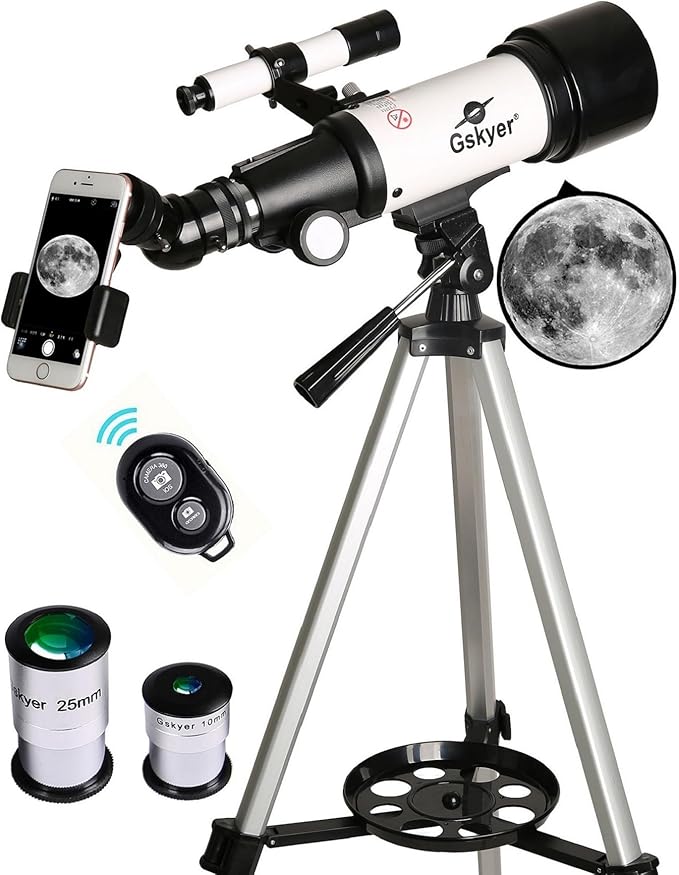
Gskyer Telescope, 70mm Aperture 400mm AZ Mount Astronomical Refracting Telescope for Kids Beginners – Travel Telescope with Carry Bag, Phone Adapter and Wireless Remote.
Superior Optics: 400mm(f/5.7) focal length and 70mm aperture, fully coated optics glass lens with high transmission coatings creates stunning images and protect your eyes. Perfect full positive telescope for astronomers to explore stars and moon.
Indications of Organic Compounds in a Faraway Moon’s Atmosphere
NASA’s research on Enceladus, Saturn’s moon, was one of the most intriguing announcements. Before, plumes of water vapor have been seen rising from beneath its icy crust by the Cassini mission. These plumes contained complex chemical compounds, according to additional study this year.
Why is this so big? Living things are made up of organic molecules. Enceladus is now one of the most intriguing locations in our solar system to look for extraterrestrial life, especially in light of indications of a sizable subsurface ocean.
Astrobiologists are calling for a special expedition to fly through these plumes using cutting-edge equipment that may identify microbial life or even amino acids. The discovery of life on Enceladus could demonstrate the universality of life in the cosmos.
Innovation in Solar Sail Power
With today’s rocket technology, it would take thousands of years to reach distant star systems. However, engineers have successfully tested a new generation of solar sails this year, which are reflecting, ultra-thin sheets that are powered by sunlight.
Solar sails may constantly accelerate without the need for fuel, possibly reaching even higher speeds over extended distances, as demonstrated by NASA’s Advanced Composite Solar Sail System.
The advantages are revolutionary:
- Heavy gasoline tanks are not necessary.
- Reduced mission expenses
- Extended mission durations
Instead of taking millennia, robotic probes could be sent to nearby stars in the future using solar sails.

Charting the Oldest Galaxies in the Universe
The results from the James Webb Space Telescope (JWST) are still astounding. This year, it recorded light from the oldest and earliest galaxies ever spotted, those generated only 300 million years after the Big Bang.
Our understanding of how quickly galaxies develop and evolve is being rewritten by this revelation. The early cosmos was predicted by astronomers to be chaotic and sparse, but these galaxies seem unexpectedly mature, full of heavy elements and stars.
The following could occur if current assumptions regarding galaxy formation are incorrect:
- The first stars in the universe evolved considerably earlier than previously believed.
- Unknown factors might be speeding up the formation of galaxies.
- We must make adjustments to our entire cosmic historical timeline.
This alters everything, for scientists, like discovering a fully grown tree in a forest that should only contain saplings.
The First Asteroid Mining Test to Be Successful
Futureists have long dreamed about mining asteroids since they are thought to contain enormous amounts of rare earth elements, nickel, platinum, and other precious metals.
Thanks to NASA’s OSIRIS-REx mission, a private space business was able to effectively retrieve and analyze material from the surface of asteroid Bennu this year. Carbon-rich chemicals found in the substance also allude to the components of life. The true excitement, however, stems from the economic potential—asteroids may provide resources for space construction, igniting a new phase of the space economy.
Asteroid mining has the potential to support space homes, fuel stations, and perhaps the return of rare metals to Earth within the next ten years.
The Implications of These Findings for Our Future
While each of these discoveries is fascinating in and of itself, taken as a whole, they show that humanity is about to embark on a new era of space travel. In contrast to the space race of the 1960s, which was motivated by political rivalry, modern exploration is propelled by:
- International cooperation between nations and private enterprises
- Advanced technologies such as reusable rockets, AI, and quantum computing
- Long-term goals for defending Earth and conquering other worlds
Over the next 20 to 30 years, we might observe:
- Permanent human habitation on the moon
- robotic space exploration missions
- Proof of extraterrestrial life
- A flourishing economy in space
Obstacles We Continue to Face
Of course, there are difficulties with space exploration:
- Expensive expenses and financial difficulties
- The risks that astronauts face from space radiation
- Space resources and politics
- Concerns regarding the ethics of changing other worlds
However, history demonstrates that technological advancement frequently gets over early challenges. For instance, the internet, which now connects billions of people, was originally a specialized military endeavor.
Conclusion
The space discoveries this year serve as a reminder that something exceptional is about to happen. We’re reaching out to touch the stars instead of just gazing at them.
We are getting closer to becoming a multi-planetary species with every step we take, whether it is discovering another Earth, demonstrating that the Moon has water, or identifying the elements necessary for life on far-off worlds.
And perhaps, just possibly, when kids stare up at the night sky in the not-too-distant future, they won’t just wonder what’s out there—they’ll know because we’ve been there.
This year’s space discoveries serve as a reminder of our boundless curiosity and desire to explore, in addition to being scientific triumphs. Every new discovery challenges our preconceived notions of what is possible, from discovering planets that resemble Earth to comprehending the early universe. These discoveries are influencing technology, changing our perspective on life, and motivating a new generation of adventurers. One thing is certain as we look to the future:
space will continue to astound us in ways we cannot ever fathom. We are fortunate to be able to observe the future of space exploration as it is developing right now, above our heads. Humanity advances in its quest to discover the secrets of the universe with every expedition and new telescopic image.