
In terms of technological development, 2025 has already shown to be a significant year. Innovation is affecting every aspect of our existence, from medical advancements that could increase life expectancy to artificial intelligence that feels nearly human. These are paradigm shifts that are altering the way we live, work, and interact; they are not only improvements.
In 2025, technology is developing at a rate that has never been observed before. Another discovery that fundamentally alters how we live, work, and interact with the outside world occurs just when we believe we have hit the limit of what is feasible. While some of these advancements already play a little role in our daily lives, this year they are taking center stage and revolutionizing entire sectors.

These ten ground-breaking technological developments in 2025, ranging from artificial intelligence (AI) that seems nearly human to medical breakthroughs that may prolong our lives, are poised to influence the future and your life in ways you may not have predicted.
Table of Contents
1. AI Assistants That Truly Understand You
Voice assistants have been around for a while, but let’s face it, they frequently feel like enhanced search engines. That changes in 2025. AI personal assistants have developed into perceptive, context-aware aides who can anticipate your requirements, carry on natural conversations, and even complete chores without your request.
These artificial intelligence (AI) systems can now comprehend your tone, preferences, and even emotional state and interface with every device you possess, including your phone, smartwatch, smart home appliances, and automobile. For instance, your AI may automatically reschedule meetings, order your favorite dinner, and recommend a little meditation break if it detects that your stress levels are rising during a hectic day.
It’s making decision-making, productivity, and wellness easier than ever before. It’s like having a personal secretary, therapist, and life coach all in one.
Rather than only responding to inquiries, advanced AI systems are able to:
- Before you ask, consider what you need.
- Produce something in your own style.
- Provide immediate emotional assistance.
- Work together on challenging assignments such as research papers or business concepts.
AI is now more user-friendly than ever, whether you’re a student, business owner, or someone simply trying to make everyday chores easier.
2. Quantum Computing Goes Mainstream
Although the term “quantum computing” has been around for a while, it is finally leaving the lab and entering practical applications in 2025. Complex calculations that would take years for regular computers to accomplish can be completed in seconds by these incredibly powerful machines.
The effects are already being felt in sectors like healthcare, banking, and climate science. Researchers are simulating new medication molecules in days rather than decades, banks are employing quantum algorithms to detect fraud almost instantly, and environmental scientists are running sophisticated climate simulations to find answers for global warming more quickly.
Although your laptop won’t be replaced by a quantum computer anytime soon, cloud-based quantum services now enable companies to harness this capability without having to buy the pricey hardware, which means that quantum innovation will proliferate more quickly than ever before.
Advantages consist of:
- instant access to smart devices.
- quicker recovery for stroke victims.
- technology that helps those with disability.
These days, we may use our mind as a keyboard instead of only our fingers.
3. Hyperloop and Next-Gen Transportation
High-speed trains were spectacular, but 2025 is demonstrating what real “fast travel” entails. Several nations currently have hyperloop systems in place, which involve passenger pods traveling at speeds of over 600 mph through low-pressure tubes.
Travel times are drastically decreasing because to this technology. By train, a journey that used to take three hours could now be completed in thirty minutes. With Hyperloop systems employing renewable energy and emitting significantly fewer pollutants than vehicles or airplanes, the environmental benefits are also enormous.
In addition to the Hyperloop, smart traffic AI and driverless electric taxis are improving the efficiency, safety, and environmental impact of city transit. We’re going more intelligently, not just faster.
For instance:
- identifying cancer in its early stages.
- forecasting heart attacks weeks before they happen.
- supplying individualized treatment programs.
With the help of this technology, lives will be saved rather than only healed.
4. Personalized Healthcare with AI Diagnosis
AI-driven diagnostics and individualized treatment regimens are driving a revolution in healthcare in 2025. AI algorithms can now evaluate your medical data in minutes rather than weeks, identifying diseases at their earliest stages with previously unheard-of precision.
Wearable technology continuously monitors your heart rate, sleep habits, blood sugar levels, and other vital signs, transmitting the information straight to your physician or AI health assistant. An immediate alert with suggested actions will be sent to you if something seems strange.
By taking a proactive stance, you can prevent illnesses from getting worse, cut down on hospital stays, and customize treatment based on your particular genetic and lifestyle characteristics.
These materials, which use nanotechnology, may fix minor problems on their own without assistance in a matter of minutes. You could:
- You can drop your phone without fear of it breaking.
- Allow the paint on your car to heal itself after a scratch.
- Utilize surfaces and furniture that will continue to seem brand new for many years.
Longer-lasting products, fewer replacements, and less trash have significant sustainability consequences.
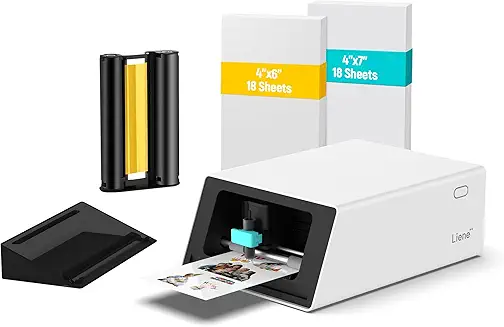
Liene PixCut S1 Color Sticker Printer & Cutting Machine – All-in-One Sticker Maker for DIY Crafts, Custom Labels & Gifts. Thermal Dye-Sublimation Photo Printer, 300 DPI, Precise AI Auto-Cutting
5. Immersive Mixed Reality (XR) Experiences
By 2025, extended reality (XR), which combines virtual reality (VR) and augmented reality (AR), will be used for purposes other than gaming. These days, XR headsets are as popular as smartphones and are lightweight and reasonably priced.
Imagine entering a store and seeing a virtual overlay with information about sustainable sourcing, reviews, and prices. Or going to a meeting at work when your coworkers show up in your living room as holographic representations. Students can perform virtual science experiments or study ancient civilizations without ever leaving the classroom, which benefits education as well.
XR is transforming remote work, learning, commerce, and entertainment into more engaging experiences than ever before.
Why it’s important
- In only a few seconds, complicated issues in finance, medicine, and climate science can be resolved.
- Your data will remain secret thanks to ultra-secure encryption.
- AI models operate more quickly and precisely.
Within ten years, quantum computing is expected to be as widespread as cloud storage, despite its high initial cost.
6. Renewable Energy Storage Breakthroughs
The problem of storing excess power for times when the sun or wind aren’t shining has always existed, despite the enormous growth of solar and wind energy. New battery technologies, such as iron-air and solid-state batteries, are resolving this issue in 2025.
At a fraction of the price, these batteries can store energy for days, increasing the dependability and affordability of renewable energy. Formerly fossil fuel-dependent communities are now completely powered by clean, stored energy, which lowers expenses and carbon emissions.
In terms of energy independence, it means that solar panels and domestic batteries can power a home for days during blackouts.
7. 3D-Printed Homes and Cities
A global issue, housing shortages are beginning to be addressed by 3D printing. Eco-friendly materials can now be used by massive robotic printers to construct entire homes in a matter of days.
These dwellings can be customized down to the last detail and are produced more quickly and at a lower cost. Entire neighborhoods are being printed in several nations, providing thousands of people with affordable accommodation.
Speed isn’t the only benefit; 3D-printed buildings are also more environmentally friendly, generating less waste and utilizing creative designs that aren’t achievable with conventional building techniques.
Benefits consist of:
- deeper and more organic dialogues with body language.
- distant meetings that are immersive.
- happenings that are virtual but seem genuine.
Think of it as Star Wars in your home room.
8. Brain-Computer Interfaces (BCI)
The concept of mind-controlling gadgets is no longer science fiction in 2025. With the use of brain-computer interfaces, people can use their thoughts to control computers, smartphones, or even prosthetic limbs.
BCIs provide unprecedented levels of independence and are transformative for those with impairments. Gamers are also exploring mind-controlled gameplay, and researchers are studying BCIs for everything from improving memory to enhancing learning speed.
Although this technology is still in its infancy for widespread use, it has the potential to conflate humans and robots in ways that we are only now starting to comprehend.
Features consist of:
- customized lesson plans.
- AI tutors are accessible at all times.
- immersive virtual reality learning environments.
This strategy is closing the gap in global education and enabling access to top-notch education everywhere.
9. Next-Gen Space Exploration
In 2025, space exploration is growing. Missions to the Moon, Mars, and beyond are being launched by both government and private organizations. Space-based solar power plants are being developed to provide clean energy down to Earth, while lunar mining for rare materials is becoming a reality.
The emergence of space tourism is arguably the most fascinating trend. While still expensive, it’s no longer limited to billionaires – more people are having the chance to feel zero gravity and see Earth from orbit.
Humanity is moving closer to becoming a multiplanetary species as a result of these developments, creating opportunities we could only imagine.
For instance:
- New York to Washington, D.C., in under 30 minutes.
- It takes 12 minutes from Dubai to Abu Dhabi.
In 2025, transport will be more efficient, cleaner, and faster than ever before thanks to autonomous electric vehicles.

10. Advanced Robotics in Everyday Life
In 2025, robots will serve as companions, personal assistants, and caregivers in addition to becoming factory workers. These days, household robots can assist with elderly or disabled care, clean, cook, and do laundry.
Robots are replacing humans in the workplace with highly precise, repetitive, or hazardous duties so that people may concentrate on strategic and creative work. Additionally, they are getting cheaper, so it won’t be long before owning a home robot is as commonplace as owning a washing machine.
You could:
- To enable individualized health monitoring, create a digital twin of your body.
- Before making any alterations, model home remodeling.
- To forecast results, model financial choices.
Final Thoughts
Tech innovation is starting to feel more like a companion in our lives in 2025 rather than just a tool. These 10 innovations aren’t just cool gadgets or science projects — they’re transformative forces changing the way we live, work, and connect.
Rapid change can be daunting, but there are also a lot of potential advantages, like cleaner energy, better healthcare, faster transport, smarter homes, and even new space exploration opportunities. Making responsible use of these discoveries to make sure they benefit everyone, not just a select few, will be crucial.
The future is already here; it is not simply coming. The upcoming years may be the most exciting period in human history if these tendencies continue.
Although we frequently imagine “the future” to be far off, 2025 demonstrates that it is actually here. Our world is already being shaped by these tech innovation, and their impact will only increase.
Early adoption allows you to:
- Boost your output.
- Improve your lifestyle and health.
- Keep up with your investments and career.
You’re living in the next phase of human development, which includes self-healing materials and AI partners.
These tech innovation will change not just individual experiences but entire sectors and economies as they become more pervasive in our daily lives. Traditional roles may change or become outdated, and new professional opportunities will arise. To get the most out of these developments, it’s critical to remain educated and adjust. Of course, issues like accessibility, privacy, and ethics must be carefully considered. But the possible advantages—more productivity, better health, increased connectedness, and a cleaner environment—far exceed the hazards. The future is promising and bright, and succeeding in the years to come will depend on embracing innovation.